
Mould in the home is not merely a matter of cleanliness or aesthetics. It is a sign of danger accumulating within the fabric of your home, which — if left unaddressed — will have a dual impact: on the health of the people living there (particularly those with allergies or asthma), and on property value, which research has found can fall by as much as 37%.
This article brings together 5 key points drawn from the guidelines of the EPA (United States Environmental Protection Agency), the NIEHS (National Institute of Environmental Health Sciences), and the Minnesota Department of Health, with one goal: to help you deal with mould problems in the home correctly, economically, and as safely as possible.
If there is one area where homeowners most frequently waste money unnecessarily, this is it. Many people, upon seeing mould, immediately call a testing company, pay laboratory fees running into hundreds of pounds, wait a fortnight for results, and receive a thick report stating “Cladosporium, Penicillium, and Aspergillus were detected” — which sounds alarming, but in reality changes virtually nothing about how the problem in their home should be addressed.
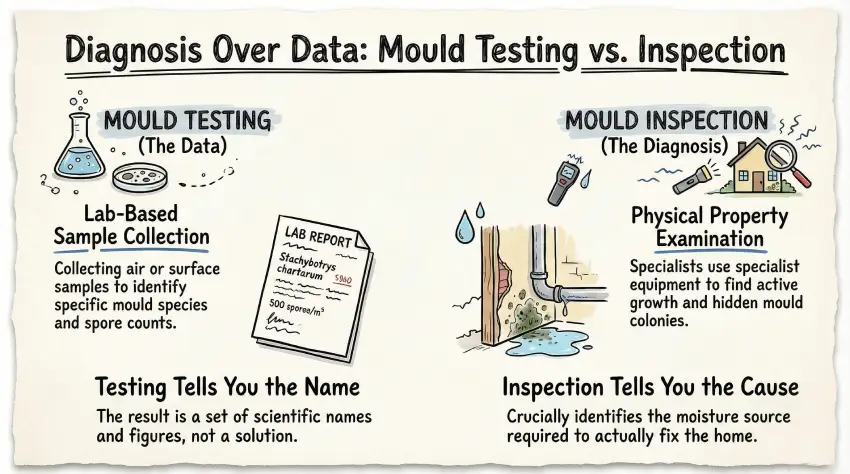
Mould Testing involves collecting air or surface samples and sending them to a laboratory in order to identify what species of mould are present and how many spores are in the air. The result is a set of figures and scientific names.
Mould Inspection involves a specialist physically examining the property — using both the naked eye and specialist equipment — to find where mould is actively growing, where it may be hiding, and, most importantly, where the source of moisture is coming from.
“Testing tells you the name. Inspection tells you the cause.” When it comes to fixing a home, you need the cause — not the name.
There is clear scientific reasoning behind this. Mould spores are present in the air everywhere on earth — both indoors and outdoors. When an air sample is taken inside a home, the results inevitably include spores that have drifted in through windows, been carried in on clothing, or blown in from nearby plants. Distinguishing which spores originated inside the home and which drifted in from outside is practically impossible.
Furthermore, the EPA has not established a standard threshold for safe airborne spore levels, because no fixed figure exists — each person’s body responds differently to spores. A laboratory result therefore cannot confirm whether a home is safe or unsafe.
Both the Minnesota Department of Health and the NIEHS concur that mould testing is rarely as useful as people assume, and recommend focusing instead on visually identifying areas of active mould growth using the naked eye and specialist tools.
In terms of cost, laboratory mould testing typically costs $250–$500 (roughly £200–£400). If mould is already visible, this money will go much further if invested in addressing the root cause directly.
Mould testing is not entirely without merit. There are circumstances in which it is genuinely warranted.
The first is in legal or insurance disputes that require documented scientific evidence. The second is when you can smell damp but cannot see any mould at all, which suggests mould may be concealed within walls or ductwork. In this case, testing can help confirm its presence before committing to more intensive investigation.
If there is one point from this article worth remembering above all others, let it be this one — because regardless of how much you know about mould, if a leak or flood is not dealt with quickly enough, everything else you know may come too late.
The principle behind mould growth is straightforward. Mould needs only one thing to begin growing: moisture. Spores floating in the air under normal conditions will not form dangerous colonies as long as there is no damp surface for them to settle on. But the moment a leak, a burst pipe, or flooding occurs, the clock starts ticking immediately.
Within 24 to 48 hours, spores that have settled on a damp surface will begin to germinate and push roots into the material. At that point, the problem is no longer merely a stain — it has become a mould colony that has penetrated deeply enough that surface wiping cannot fully eradicate it.
Drying an area within the first 48 hours is therefore far more effective at preventing mould than purchasing expensive anti-mould products after the problem has been left to develop.
The EPA and NIEHS recommend keeping indoor relative humidity between 30% and 50%, and no higher than 60%. When humidity exceeds this level, the home environment becomes directly conducive to mould growth, even in the absence of any leak.
In areas with persistently high humidity, relying on air conditioning alone may not be sufficient — particularly in closed rooms that are rarely used. Improving ventilation helps prevent water vapour from accumulating on walls and ceilings.
For those seeking comprehensive indoor air quality control, read more: How Air Purifiers Help Eliminate Mould Spores
Summary: When a leak or flood occurs, you have 24–48 hours to dry the area completely. That is a window of opportunity you cannot afford to miss — the cost of remediation and mould removal afterwards can be many times greater.
One of the most common errors at the removal stage is applying the same method to every surface — which in some cases is not merely ineffective, but actively worsens the problem.

Materials in this category include tiles, metal, glass, and plastic. Their shared characteristic is a non-porous surface, meaning mould adheres only to the outermost layer and cannot penetrate into the material itself. For surfaces of this type, scrubbing with detergent and clean water, followed by drying thoroughly immediately afterwards, is generally sufficient to remove surface mould completely, and the surface can then be returned to normal use.
Materials in this category include carpet, wallpaper, ceiling tiles, foam panels, and drywall. Once mould in the home has embedded itself in these materials, it penetrates into deeper layers that hands and cleaning products cannot reach. Scrubbing the surface may make it look temporarily cleaner, but the root structure of the mould remains within and will re-emerge before long.
The correct answer for porous materials contaminated with mould is one and the same: remove and replace them. There is no other option.
If there is one widespread misunderstanding in managing mould in the home, this is it. Almost everyone who encounters mould begins by reaching for bleach, white vinegar, or a disinfectant spray, applying it liberally, waiting for it to dry, observing that the stain has gone, and concluding that the problem is solved. In reality, that is the beginning of the next round of problems, not the end of the current one.
This is a deeply ingrained misconception — that once mould is dead, the problem is over. Scientific fact tells us otherwise: “dead mould” continues to release allergens indefinitely. The protein structures within mould cell walls do not break down upon death. Dead, desiccated spores continue to float in the air and trigger respiratory reactions in susceptible individuals just as readily as living mould.
The reality is that mould spores exist everywhere on earth — in outdoor air, in household dust, on the clothes we bring indoors, and even in the cleanest of homes. No home in the world can achieve a zero spore count without installing laboratory-grade air filtration.
The true and achievable goal is to bring spore levels back to a normal level that the average person’s body can tolerate without reacting. The single most important means of achieving this sustainably is moisture control — because as long as the moisture source remains, mould will always return, regardless of how powerful the products used.
One reason mould treated at home recurs so frequently is that people can only see what is on the surface — unaware that the real source is concealed elsewhere. Common hiding places that are frequently overlooked include:
Important warning: If you suspect there is hidden mould, do not strip wallpaper or remove wall panels yourself without proper containment measures in place. Doing so will cause an immediate and massive dispersal of spores, which poses serious risks to everyone in the home.
When considering the health risks of mould in the home, most people think only of sneezing, a blocked nose, or red eyes — common allergic reactions that are well recognised and appear quickly. However, data from NIEHS indicates that the long-term effects run considerably deeper. In those exposed to mould accumulation over prolonged periods, associations have been found with:
For families with small children, the elderly, or members with low immunity, these risks are even more amplified. And that is why maintaining the air quality in your home must be an ongoing commitment, not just when a problem is visible. Read more: How Mould Allergies Affect Health
Summary: Correctly addressing mould in the home requires two things simultaneously: physical removal (not merely killing) and eliminating the moisture source. Doing only one or the other will always allow the problem to return.
If the first four points addressed health and practical management, this one concerns money and property value. The figure of 37% is not an exaggeration or a scare tactic — it is drawn from real data reflecting the behaviour of the property market. If you are buying or selling a home, the information in this section may be directly relevant to you.
The impact of mould on property value arises from two pressures working simultaneously.
The first is structural damage. Mould does not merely sit on the surface — it gradually consumes timber, drywall, and other building materials. If damage has accumulated over many years without being detected, it can compromise structural integrity to the extent that large sections must be stripped out and replaced, with repair costs potentially running into tens of thousands of pounds.
The second is emotional devaluation. In many cases, this psychological impact is more severe than the physical damage. When a buyer learns that a property has a history of mould, concerns about the “unseen” immediately take over. Was it fully removed? Will it return? Has the structure been affected elsewhere? These questions translate directly into aggressive price negotiation.
A concise summary of the 5 key points covered in this article:
Prevention today is always simpler and less costly than remediation once mould has taken hold.
Everything covered above concerns managing mould at its source — which is crucial. But there is one further dimension that many people overlook: the quality of the air you breathe every day inside your home.
Because no matter how well moisture is controlled, spores from outdoors will always find their way in. For families with young children, elderly members, or individuals with allergies and asthma, having a reliable air filtration and purification system in the home provides an additional layer of protection that truly matters.
The integration of an Air Purifier for Mould becomes critical when addressing the invisible threat posed by airborne spores. While physical removal and moisture control resolve the root issue, they do not instantaneously eliminate the millions of spores that are either carried in from outside or released during the cleaning process.
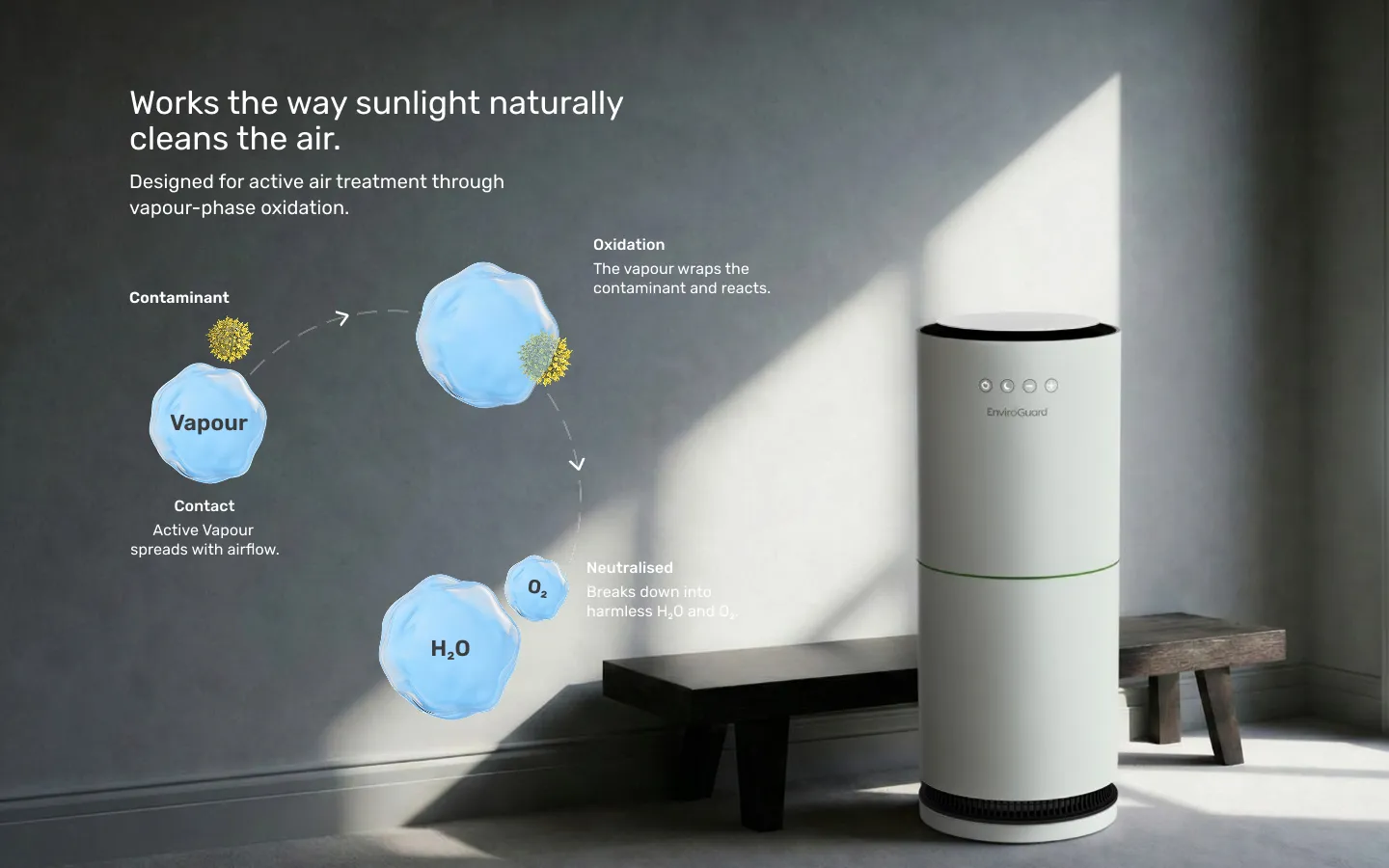
What sets the VBreathe EnviroGuard PRO™ X apart from standard air purifiers on the market is a fundamentally different design philosophy. Conventional air purifiers work passively — waiting for air to pass through a filter before cleaning it. This means any air that does not flow through the unit continues to carry spores in the meantime.
VBreathe employs an Active Dual Approach, combining two systems:
The result is a reduction of mould, bacteria, and viruses in the home by more than 99% — both in the air and on surfaces — bringing conditions close to the standards used in hospitals, clinics, and healthcare facilities.
Can I remove house mould myself?
Yes, provided the affected area is no larger than 10 square feet and sits on a hard surface. If it’s larger than that, or on porous materials such as carpet or ceiling tiles, you should always call a professional.
Does a musty smell in the house always mean there’s mould?
Not always, but an unexplained musty odour is a warning sign that shouldn’t be ignored. Hidden mould inside walls or beneath flooring often leaves no visible trace whatsoever.
How quickly should a water leak be dealt with?
Within 24–48 hours. That’s the window before mould spores take root in building materials. If the area is dried out within that time, the chance of mould forming is almost nil.
Can an air purifier help reduce mould in the home?
It can, but you’ll need to choose an air purifier for mould that works actively — one that treats both the air and surrounding surfaces simultaneously, rather than simply filtering air that passes through the unit.
Remove
Total Amount
Your personal data will be used to process your order, support your experience throughout this website, and for other purposes described in our privacy policy.
Adding {{itemName}} to cart
Added {{itemName}} to cart